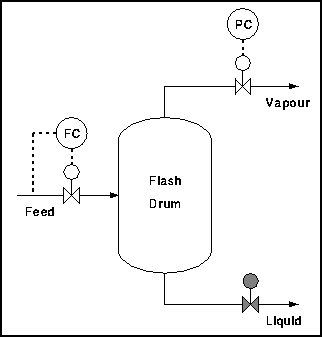
Figure 1 - Feed Rate Controlled - 1
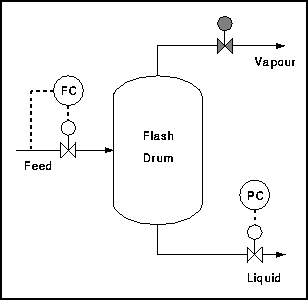
Figure 2 - Feed Rate Controlled - 2
It is now possible to devise control schemes for this adiabatic flash vessel. The basic input-output block has 3 streams. It has been evaluated above that there are 2 control degrees of freedom which means control valves on two of the three streams. That leaves one other stream which also has a control valve on it to regulate inventory i.e. to ensure that the mass balance does in fact balance.
Of the two streams left one would normally have a flow controller and be used to regulate throughput. This could be any of the three streams. This leaves one other to regulate a strategic variable.
From a knowledge of the properties of the adiabatic flash, the normal design specification is the feed and only one further quantity, usually pressure, but temperature or another flow could also be chosen.
For this example we will choose to regulate the pressure and one flowrate, not necessarily the feed. This gives rise to six different alternatives. Each one is shown below with a short discussion on whether it is feasible or not. Note that the shaded valve indicates a valve used for inventory regulation. Not shown is the controller and level measurement. Since all measurements in this example orginate in the flash drum that end of the loop is omitted to simplify the diagrams.
Figure 1 - Feed Rate Controlled - 1
Figure 2 - Feed Rate Controlled - 2
Figure 1 is a very common arrangement and will work well. Both pressure and level loops have good adjustment-measurement sensitivity. There is some undesirable interaction because opening the pressure control valve increases the rate of boiloff and hence affects the level.
Figure 2 will not work. Although as noted above the vapour rate affects level, altering the liquid rate does not change the pressure of the flash.
Figures 3 and 4 below are the alternatives for regulation of vapour rate and pressure.
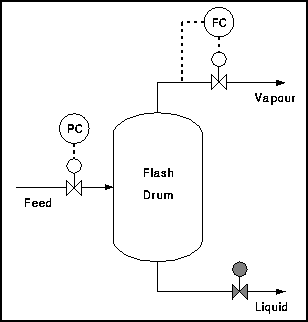
Figure 3 - Vapour Rate Controlled - 1
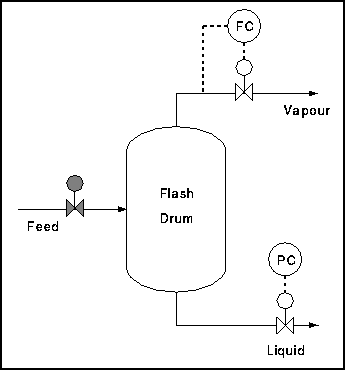
Figure 4 - Vapour Rate Controlled - 2
Figure 4 is unworkable for the same reasons given above for figure 2.
Finally figures 5 and 6 give the two alternatives for liquid rate and pressure.
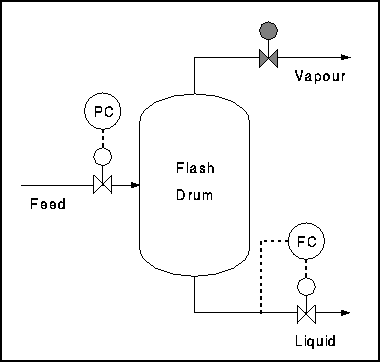
Figure 5 - Liquid Rate Controlled - 1
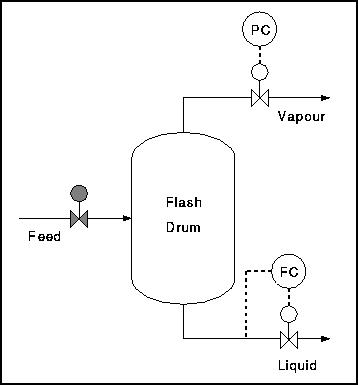
Figure 6 - Liquid Rate Controlled - 2
It would be possible to devise other schemes in which the flow control loop acted indirectly. For example, by adjusting a stream other than the one which is measured as shown below in figure 7. Such arrangements should be avoided, as should any system in which the operation of one loop, here the flow control, depends also on the operation of another, here the inventory loop.
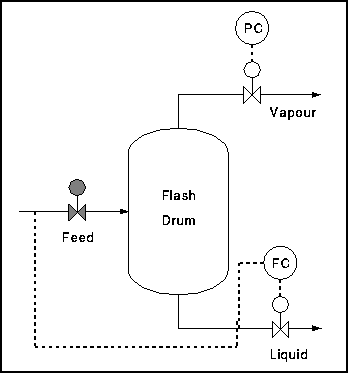
Figure 7 - Another Possibility?
Please move Back to previous page