
Figure 1 - Degrees of Freedom Analysis of Distillation Column
Degrees of Freedom Analysis in Process Control, Chemical Engineering Science, 1994, Volume 49, No. 13, pp 2089 - 2095
to determine the number of control degrees of freedom in a distillation column. There are two equivalent procedures based on the equation -
C.D.F. = Total No. of Streams - No. of Phases Present + 1
All we have to do is count all the streams in the process. Separately count the total number of extra phases i.e. add up all occurrences of phases greater than one in all units. The number of control degrees of freedom is the difference between these two numbers.
Figure 1 below shows this method.
Figure 1 - Degrees of Freedom Analysis of Distillation Column
So the number of degrees of freedom is 5. However, a typical control strategy for such a process would use only 4 of these - feedrate, column pressure, top and bottom composition. This is because the column and condenser are normally maintained at the same pressure.
However, a valve could be placed in the line between. This would actually be undesirable as reducing the condenser pressure will decrease the temperature driving force available from the cooling medium.
One thing to note is that in none of them is a valve simply placed on the vapour line. This would lead to the use of a large expensive control valve. Instead the pressure is controlled indirectly involving the use of the condenser and/or reflux drum.
Figure 2 below shows the easiest way to control the pressure in a column operating at atmospheric pressure.
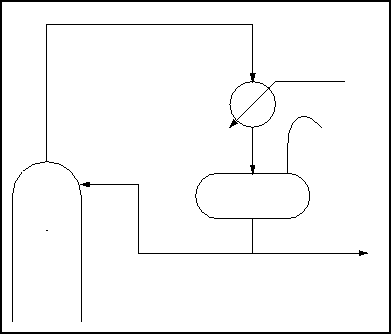
Figure 2 - Vent to Atmosphere
In this case the cooling water flow stays constant and the reflux drum is vented to atmosphere. Thus the reflux drum and hence the top of the column are at atmospheric pressure. The advantage of this scheme is that it requires one less control valve. The disadvantage is that the tops have to be subcooled so that a minimal amount of vapour is lost through the vent. Hence more energy is required from the reboiler when the reflux is added to the top of the column.
Figure 3 shows the most common method for controlling the pressure - adjustment of the cooling water flow.
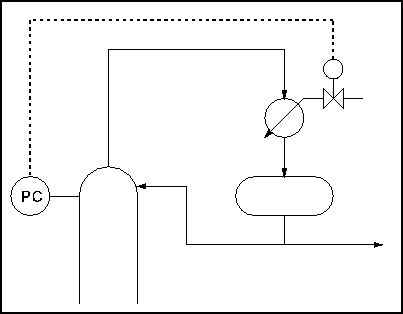
Figure 3 - Cooling Water
In this case if the cooling water flow is increased then more vapour is condensed and the vapour pressure is reduced (and vice versa).
Figure 4 shows the classic flooded condenser approach.
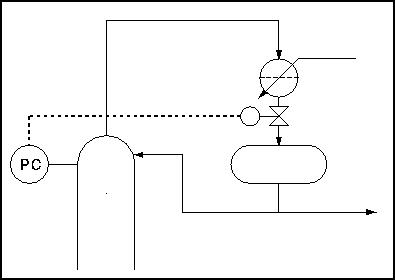
Figure 4 - Flooded Condenser - 1
Again in this setup, as with the first example, there is no valve on the cooling water. Instead the valve is in the liquid line between the condenser and reflux drum.
If this valve is closed then the condensed vapour i.e. liquid will build up and flood the condenser. This has the effect of reducing the heat exchange area, thus reducing the amount of vapour being condensed and hence increasing the pressure.
The valve can then be opened, the liquid level will fall, increasing the heat exchange area and hence decreasing the pressure.
Figure 5 shows an alternative arrangement for a flooded condenser.
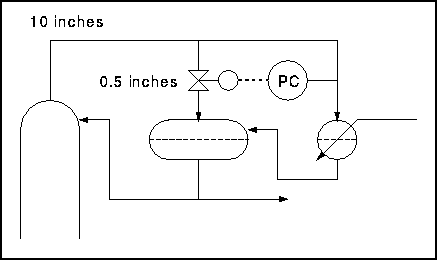
Figure 5 - Flooded Condenser 2
The first thing to notice about this setup is that the reflux drum and condenser are at the same level. The second important point is that the vapour line, on which there is the control valve, is very small in comparison with the overhead line. If the valve is opened there is a small escape of gas into the reflux drum. This pushes the liquid level down in the drum and up in the condenser, flooding it and reducing the heat exchange area as in the last example.
Therefore to increase the pressure the valve is opened and to decrease the pressure the valve is closed.
The final example is the control of a partial condenser.
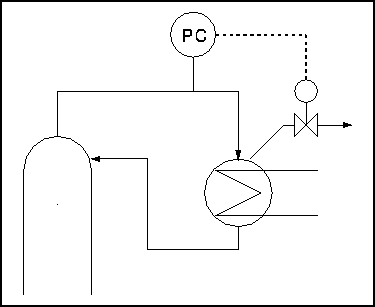
Figure 6 - Partial Condenser
The above scheme is used if the overhead product is required as a vapour.
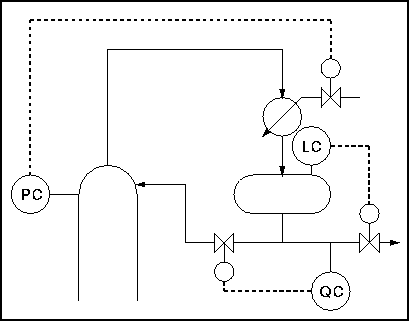
Figure 7 - Reflux Rate
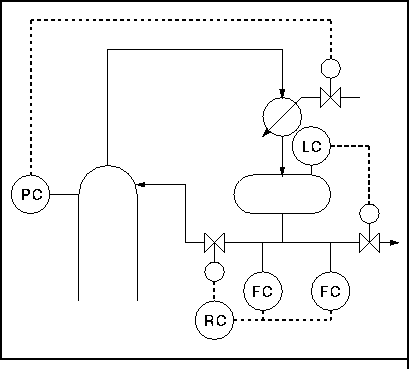
Figure 8 - Reflux Ratio
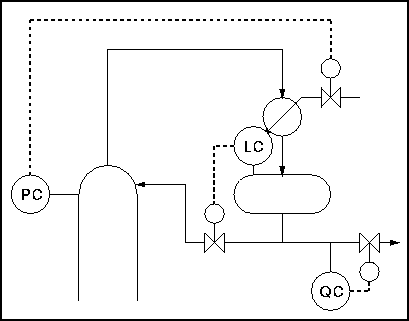
Figure 9 - Distillate Rate
This is a fairly standard configuration for a single product column, i.e. when the bottoms streams is a byproduct, recycle or goes to further processing.
Although the overheads composition is regulated by adjusting the steam rate at the base of the column, the response of the column to heat input changes is quite rapid, and so this strategy is acceptable.
Pressure control on condenser cooling water is shown; of course any other pressure control scheme would be acceptable.
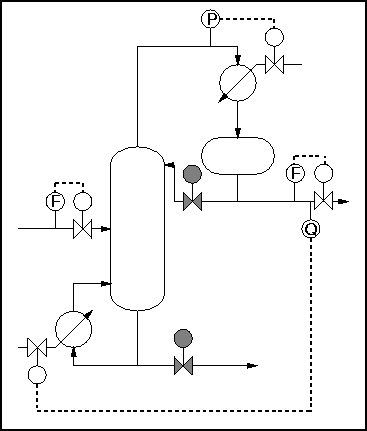
Figure 10 - Overheads Rate and Composition
This does not work well, since either the bottom level, as here, or composition, has to be regulated by adjusting the reflux rate. In either case the loop involves a long delay due to the hydraulic lags on each tray.
It is probably marginally better to regulate composition by steam rate since this is a more important quantity than level, although the two loops could be interchanged with the steam adjusting the level, which is quite a good scheme, and the reflux manipulating the bottoms composition, which is very poor. Fotunately this is an unusual requirement, as main products normally come from the top of columns for other reasons.
A standard flooded condenser pressure control system is shown.

Figure 11 - Bottoms Rate and Composition
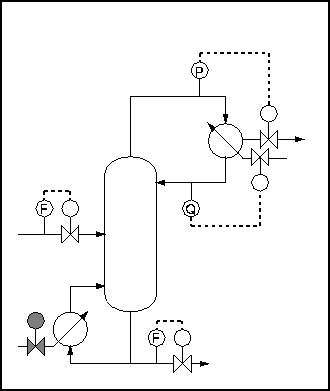
Figure 12 - Bottoms Rate and Overhead Composition, With Partial Condenser
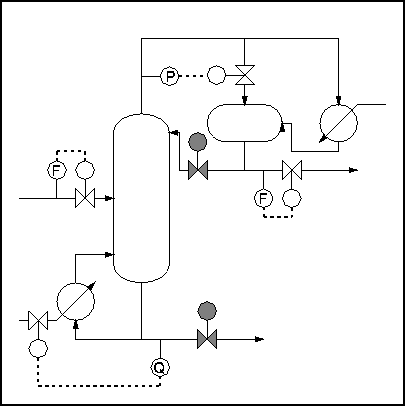
Figure 13 - Overhead Rate and Bottoms Composition
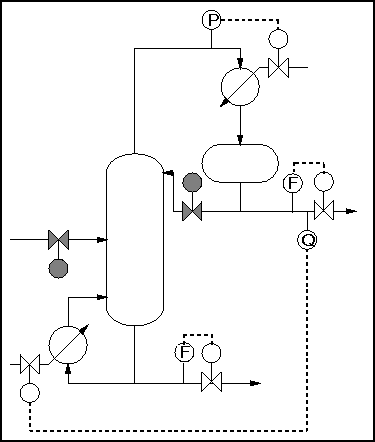
Figure 14 - Bottoms Rate, Overhead Rate and Composition
Return to start of Module 3: Control Systems For Complex Processes