This part of the course starts with an outline and overview of basic control concepts. Questions which process engineers routinely have to answer about process control include the following:
Most books with the words `process control' in the title do little to answer these questions. Classical linear control theory, which forms the basis of most books on control, is much concerned with how to design controllers and is less helpful on how to design complete control systems. Other problems with this classical approach, for most process engineers wishing to design control systems for real chemical processes, are the restriction of most of its methods to idealised process models, and the extensive use of rather specialised mathematics.
Satisfactory answers to questions such as the above frequently require little conventional mathematics. What they do require, however, is a good understanding of what a process is intended to do and how it works.
In this book we will approach process control from the standpoint of a chemical or process engineer, and address these questions and others like them. We will consider the process and its control system in the language of process engineering. We will use mathematics, as such, only when necessary, and the language of classical control engineering only when it is unavoidable, or will add very significantly to the process engineer's understanding.
A chemical plant might be thought of as a collection of tanks in which materials are heated, cooled and reacted, and of pipes through which they flow. Such a system will not, in general, naturally maintain itself in a state such that precisely the temperature required by a reaction is achieved, a pressure in excess of the safe limits of all vessels be avoided, or a flowrate just sufficient to achieve the economically optimum product composition arise.
Control systems in chemical plants have, as noted, three functions.
To a large extent these are quite separate objectives. Indeed, in the case of safety systems separate equipment is generally used. The aims of control for operability are secondary to those of strategic control for quality etc., which directly affect process profitability.
These active safety systems must be robust and of high integrity. Current processes achieve this through simplicity. The ultimate safety system is in most cases the mechanical relief valve which simply vents the plant to atmosphere, possibly through a flare or scrubber.
We will not discuss control for safety explicitly in this book. Generally speaking a complete and separate system is provided to handle emergency control action. The need for this, and its design requirements, are established in hazard and operability or hazop studies. These are typicaly carried out on the complete process with its `normal' control systems in place.
A number of safety issues will be addressed in the course of developing the design of the control systems for normal operation, but it must be emphasised that our treatment of this vital issue will be relatively restricted.
The issue of making a plant behave in this way is called operability.
The majority of control loops in a plant control system are associated with operability. Specific flow rates have to be set, levels in vessels maintained and chosen operating temperatures for reactors and other equipment achieved.
The top level of process control, what we will refer to as the strategic control level is thus concerned with achieving the appropriate values principally of:
Such an algorithm might be:
If the temperature is too high then turn the heater off. If it is too low then turn the heater on.
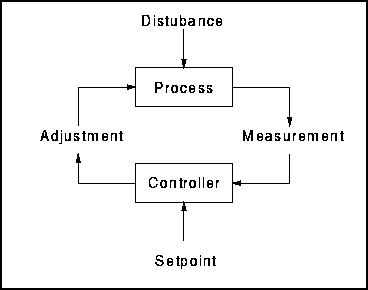
Feedback control action is entirely empirical, so long as an adjustment is being made in the correct `sense', e.g. more heat means increasing temperature and vice versa, then the control system should remove the effect of an external disturbance.
As we will see, it helps to know more than this, but the minimum information required to make a feedback control system work is whether the adjustment makes the measurement go up or down.
Large Magnitude Disturbance
A very large disturbance may cause an unacceptable upset in a process before the control system can comp[enstae for it. This is most likely to occur when the relationship between the disturbance and the regulated variable is a nonlinear one in which an increasing disturbance leads to a disproportionate change in the variable.
A classic example of this is an exothermic chemical reaction whose temperature is to be regulated. Here anything that causes an increase in temperature will cause an increase in reaction rate, leading to a further increase in temperature, etc.
This is exacerbated by the extreme sensitivity of rate to temperature by the Arrhenius equation:
rate = A exp (-E/RT)
Typically a 10K rise in temperature can doubble the reaction, and hence heat production rate.This is a situation in which feedforward control can usefully be added to a feedback control system.
Large Time Delay
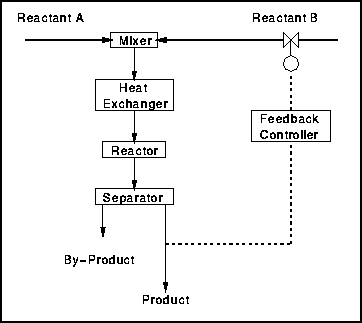
It is almost always necessary to regulate the product from a process. Sometimes the only way of doing this is to adjust the feed. This puts the whole process inside the control loop, and so it may take many minutes, or even hours, for the effect of any feed adjustment to be observed in the product, see figure.