Basic Requirements
In
order to control the process performance, we need
a control system, which consists of a sensor, a controller and
a final control element. Obviously, the sensor is a very important part of
the control system.
It monitors the process and
serves as a signal source for the control system.
In our
previous discussion, we always assumed, there
was some suitable measuring device available, but not all
measuring devices can be used in automatic control. The basic requirements
for a sensor used in a control loop are the abilities :
- to indicate the values of measured variables
- to transmit the signals to the controller
The signals could be transmitted through either a electric circuit
or a pneumatic pipeline, therefore,
in order to transmit the signal, the sensors must have the ability to
convert the measured variable values into either electric signals or
pneumatic signals.
In this section of the course, we will very briefly
discuss some kinds of sensors used in process control. However it is not intended
to examine their working mechanism in any detail.
Common variables in Chemical Engineering covered in the following
discussion are pressure, temperature, flowrate,
and liquid level. Analytical instruments for
chemical composition measurement are usually specially
designed for the specific purpose and hence are not included.
Many kinds of pressure transducers are widely used in
industry for pressure measurement. Although devices
like the manometer and Bourdon tube etc are quite
common, they are not suitable for control purposes
due to the difficulties
for signal transmission.
In most pressure transducers,
there is a diaphragm to contact the fluids and
protect the measuring setup isolated from the
measured fluids, most of which may be corrosive.
Due to the existence of this diaphragm,
most pressure transducers can
be used as pressure differential transducers, as long
as the second (lower) fluid is introduced into the
other side of the diaphragm. Actually, when
measuring the pressure, it is measuring the
pressure difference between the measured pressure
and the pressure of atmosphere guage pressure.
Strain meter (resistance):
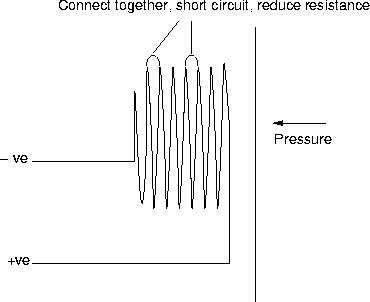
- In this sensor, under the diaphragm
there is a pressure sensitive electric
resistance. It is a spring type of resistance wire. Under pressure,
some of the spring is pressed together causing a short
circut and reducing the resistance. The resistance
will be inversely proportional to the strain on it,
or the pressure. This changing resistance may be
measured by being included into a electric circuit.
The electric signal, current or voltage, is easily transmitted.
Piezo - electric sensor:
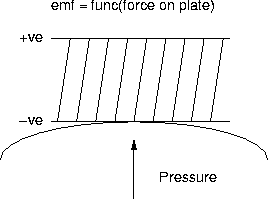
- In this sensor, under the diaphragm is a quartz crystal.
The working principle is based on the characteristics of quartz crystal.
If the crystal is cut in a special way
and placed between two plates, then
the electromotivated force (e.m.f) set up between the plates
will be a measure of the pressure applied to the
crystal. This property of crystal is called piezo-electric
effect. By measuring this e.m.f. setup, the applied
pressure can be indicated and transmitted. This technique is mainly
used for higher pressure measurements.
Traditional transducer (air pressure transmitted):
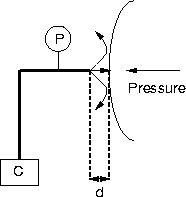
- The principle of this system is that the pressure on a
diaphragm is arranged to control the flow of air into,
or out of, a chamber on the opposite side of the
diaphragm, until a balance is obtained. The
balancing pressure is an indication of the
measured pressure. In this case, the measured signal is transmitted
in a pneumatic circuit through the air pipeline.
Level Measurement
Pressure operated sensor:
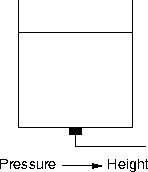
- As there exists a unique quantitative relationship between
the liquid level (head) and the static pressure at the bottom of
the tank, the latter is widely used as an indication of the
liquid level. Thus this is another case of pressure measurement and pressure
transducers discussed above could be used for level measurement.
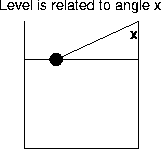
Float operated sensor:
- In this kind of system, there is a float on the surface
of liquid. The change in liquid level will cause movements of
this float. By monitoring this movement a signal of the level
is generated and transmitted.
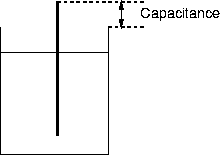
Capacity bridge sensor:
- This equipment consists of an electrode, an electronic unit and
an indicator (or transmitter). The electrode is in the form of a long
metal rod which reaches from the top to the bottom
of the vessel. The electrode is bare when the liquid is
electrically non conducting, but is sheathed in polymer
like polyethlene etc when the liquid is conducting.
The electronic unit is merely a power
supply and a highly stabilized capacitance measuring bridge.
One arm of the bridge is formed by the capacitance between
the level sensing electrode and the earth (the vessel wall). A
change in the capacitance owing to the rise and fall of
the material around the electrode produces an out-of-balance
current flow from the bridge which is measured and transmitted.
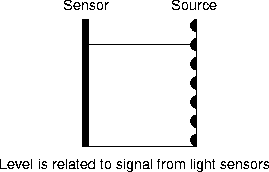
Optical sensor:
- This kind of sensor
is based on the difference in the reflecting and transparent
properties of liquid and the gas above it. It takes the form of a
light source and a receiver to the reflected light. When there is
no liquid around, the receiver can detect the reflected light,
and this light signal is converted to a electric signal
which can be transmitted. When the sensor is surrounded
by liquid, the receiver can't get the same amount of
light reflected. The change
in the light received is then converted into the change in the electric signal
which is indicative to the amount of liquid. Thus
to monitor level, you need a number of these kinds of sensors in series,
spread over the whole height of the tank. This signal can also be transmitted.
Flow Measurement
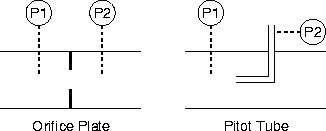
Differential Pressure Method:
- This is still the most commonly used method.
Whatever the construction of the meter, the
principle involved is same. The net cross-section
area of the stream is reduced, causing an increase in the velocity, and
hence an increase in kinetic energy.
This increase in kinetic energy is obtained
at the expense of pressure energy, so that
the pressure of fluid is reduced.
By measuring this pressure reduction, or
the pressure differential, the velocity of
the fluid can be calculated. Examples of this kind are orifice plates and
Venturi tube. The nature
of this measurement is to measure the pressure differential
and then to use pressure transducers.
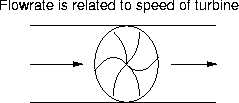
Rotating vane meter:
- Liquid passing through the meter is directed
on to the rings of the vane, and rotates it at a rate which
depends on the velocity of the liquid. This
rotation can be arranged to drive some electric transducers
to give out electric signal, like frequency.
Temperature Measurement
Resistance thermometer and thermistor:
- The electrical resistance of metals depends on temperature.
By measuring the changing resistance, the temperature can be
determined. The change in resistance can easily be converted to a
electrical signal transmittable. Commonly used thermometers are
made of Platinum or Nickel because they have a
stable and preferable resistance-temperature coefficients.
A thermistor is made of semiconductor,
a mixture of metal oxide. Unlike metals, the semiconductors
have a negative resistance coefficient.
This is the main difference between a thermometer and a thermistor.
Thermocouple:
- If an electric circuit consists of all metallic conductors
and all parts of the circuit are at the same temperature, there will be no
electric force in the circuit, and hence there is no current. However,
if the junctions between two metals are at different temperature, then
there will be an e.m.f. and a current will flow. This e.m.f is
called the thermoelectric e.m.f. , and the junction between
the two metals is a thermocouple.
The e.m.f will depend on the temperature difference between the
two junctions. Therefore, when one junction (cold end) is kept
at zero degrees, the e.m.f will indicate the temperature of the heated
junction (measured temperature).
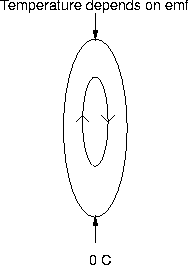
It has been shown the electric circuit for transmitting this
signal does not alter the signal itself, which is indicated by the
law of intermediate metals
which states: In a thermoelectric circuit composed
of two metals A and B, with junctions at temperature T1 and T2, the
e.m.f is not altered if one or both the junctions
are opened and one or more metals are interposed between A and B,
provided that all the junctions
by which the single junction at temperature T1 may be replaced
are kept at T1, and all those by which the junction
at temperature T2 may be replaced are kept at T2.
Silicon semiconductor:
- Diodes have an important parameter called
pass-required voltage. Below this voltage, there is no
current through the diode. Above this voltage, the diode allows
current to pass through.
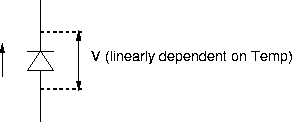
The pass required voltage of silicon diodes depend uniquely on
temperature, and thus this voltage signal can be used to indicate
temperature.
The main advantage of silicon semiconductor
thermometers is that this
pass-required voltage has a temperature coefficient
which is essentially the same for all silicon devices of -2mV/ degC,
and this linear change feature is a great advantage for control porposes.