Feedforward Control
In this configuration, a sensor or measuring device
is used to directly measure the disturbance as it enters
the process and the sensor transmits this information to
the feedforward controller. The
feedforward controller determines the needed
change in the manipulated variable, so that, when
the effect of the disturbance is combined with
the effect of the change in the manipulated variable, there will be no
change in the controlled variable at all.
The controlled variable is always kept at its setpoint and hence
disturbances have no efffect on the process.
This perfect compensation is a difficult goal to obtain.
It is , however, the objective for which feedforward control
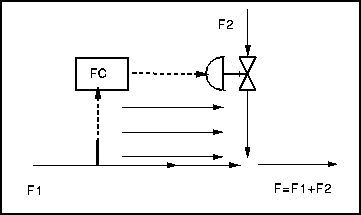
is structural. A typical feedforward control loop is shown in the
figure below.

Another name for feedforward control is open loop control. The
reason is that the measured signal goes to the controller parallely to
the process. This can be seen in the next figure. This is in contrast
to feedback or closed loop control.
As mentioned previously the main advantage of feedforward control is
that it works to prevent errors from occuring and disturbances have no
effect on the process at all. However, there are some significant difficulties.
- Complex Computation
The feedforward control computation involves
determining exactly how much change in manipulated variable
is required for a specific change in disturbance.
To be able to make this computation accurately requires
significant quantitative understanding of the process and
its operation. There is also a tremendous escalation of the theoretical
know-how required in the feedforward controller's computation
activities.
- Knowledge of Process
The structure of feed forward control assumes that
- The disturbances are known in advance.
- The disturbance will have sensors associated
with them (measurable).
- There will not be significant
unmeasured disturbances.
These limitations on the disturbances
constrains the application of feedforward control, simply as most
disturbances in the industrial processes are unpredictable and
unmeasurable.
- Limitations
In pure feedforward control, there is no monitoring on the
controlled variable. If the controlled variable strays from its
setpoint there is no
corrective action to eliminate the error.
This makes pure feedforward control somewhat impractical and
a rarity in typical process application.
- Specific Controller Required
The feedforward controller must be
specifically and uniquely designed for the one particular
control application involved, because of the necessity of
accurate and quantitative calculations.
It can be seen that feedforward control requires a
significant increase in technical skills
and capabilities. As a result,
feedforward control of specific variables is limited
to the most economically significant cases. In practical industrial
application, only few cases are handle with
feedforward control. While the number of application is
small, their importance is quite significant.
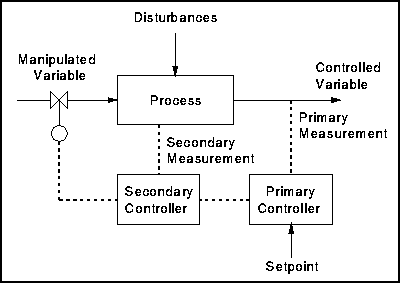
The second alternative to simple feedback control is cascade
control. In this setup there is
- one manipulated variable
- more than one measured variable
An inner and outer control loop are formed each with an individual feedback
controller. The outer loop controller is also known as the
master or primary controller.
- The input to this controller is the measured value of the variable
to be controlled.
- The setpoint is supplied by the operator.
- It passes its output signal to the inner control loop.
The inner loop controller is known as the slave or
secondary controller.
- It measures a second variable whose value affects the controlled variable.
- The setpoint is supplied by the output from the outer loop.
- Its output signal is used as the signal to the manipulated variable.
The above points can be shown clearly in a diagram.
The major benefit from using cascade control is that disturbances arising
within the secondary loop are corrected by the secondary controller
before they can affect the value of the primary controlled output.
Cascade control is especially effective if the inner loop is much faster
than the outer loop and if the main disturbances affect the inner loop first.
Below are described examples of cascade control in practise. It should
be noted that in two of the three examples, the secondary loop is used
to compensate for flowrate changes. In process systems this is
generally the case.
Example 1 - Reactor Temperature Control
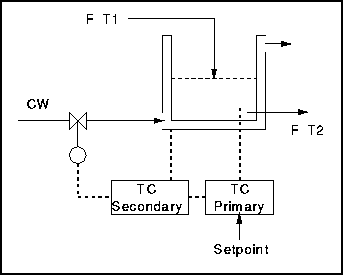
In this example the aim is to keep T2 at its setpoint. The primary
control loop detects and eliminates changes in T1, the temperature of
the reactants. The secondary control loop detects changes in the
temperature of the cooling water. Hence it can adjust the flow
accordingly before the effects are detected by the primary
control loop. If there was no second controller the effect of the
cooling water would take a long time to materalise and hence eliminated.
Example 2 - Distillation Bottoms Temperature Control
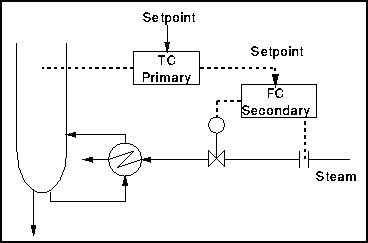
In this example the primary loop detects changes in the temperature
brought about by changes in composition, pressure, etc. The secondary
loop detects changes in the steam flowrate and hence eliminates
anticipated effects on the temperature.
Example 3 - Heat Exchanger Temperature Control
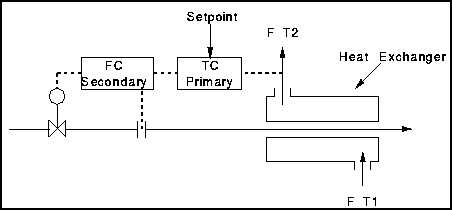
This is similar to example 2. The aim is to keep T2 constant. Again
the secondary loop is used to compensate for flowrate changes.
The final alternative to simple feedback control to be discussed in
this section is Split-Range Control. This is distinguished by
the fact that it has
- one measurement only (the controlled variable)
- more than one manipulated variable
The control signal is split into several parts each associated with one
of the manipulated variables. A single process is controlled by
coordinating the actions of several manipulated variables, all of which
have the same effect on the controlled output.
Below are described two situations where split-range control is used in
chemical processes.
Example 1 - Control of Pressure in a Reactor
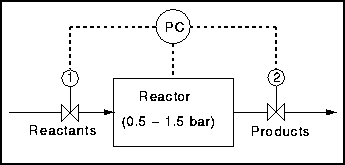
The aim of this loop is to control the pressure in the reactor. It may
be possible to operate this system with only one of the valves but the
second valve is added to provide additional safety and operational
optimality.
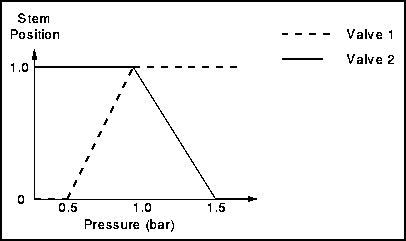
In this case the action of the two valves should be coordinated. Thus
for example if the operating pressure is between 0.5 and 1.5 bar then
the control algorithm could be
- If the pressure is below 0.5 bar then valve 1 is completely open and
2 is completely closed.
- If the pressure is between 0.5 and 1 bar then valve 1 is completely
open while 2 is opened continuously as the pressure rises. Note that
both these actions lead to a reduction in pressure.
- If there is a large increase in pressure and it rises to above 1 bar
then valve 2 is completely open while 1 is closed continuously.
- If the pressure reaches 1.5 bar then valve 1 is shut and 2 is open.
A graph of these valve positions with respect to pressure is shown below.
Example 2 - Control of Pressure in a Steam Header
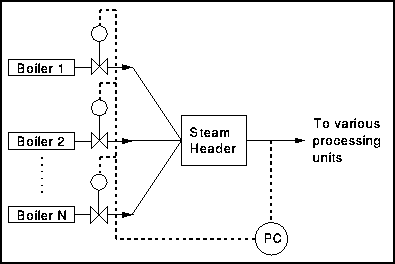
The aim of this control loop is to maintain a constant pressure in the
steam header subject to differing demands for steam further downstream.
In this case the signal is split and the steam flow from every boiler is
manipulated. An alternative manipulated variable could be the steam
production rate at each boiler via the firing rate. A similar control
scheme to the above could be developed for the pressure control of a
common discharge or suction header for N parallel compressors.
Return
to Start of Part 1 - Basic Concepts