In all the examples so far discussed it has been assumed that we know at the outset what quantity is to be measured and thus regulated, and what will be the corresponding adjustment. This information will in fact be readily available only for the simplest of cases.
As soon as we consider the control of any sort of process, or even a modestly complex piece of equipment, we are faced with the need to provide several control loops. The result of this is to create a range of choices. In this section, we introduce ideas to help resolve this choice systematically. These ideas will enable us to design complete control systems for large and complex processes, although they will first be introduced in the context of simple examples.
In our case we are concerned with the Control Degrees of Freedom which will be the number of the above types of process variable which may be set once non-adjustable design variables, such as vessel dimensions or number of trays, have been fixed.
In this context the number of degrees of freedom thus corresponds strictly to the number of manipulated variables which may be used in control loops. Note that this is also the number of single-input-single-output control loops and of regulated variables in the loops.
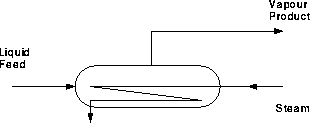
To illustrate the nature of the problem, consider how a process unit which vaporises a liquid feed stream might be controlled.
The first question to be resolved is which and how many of these can legitimately be regulated independently?
Similarly, what adjustments may be made in order to regulate the chosen quantities? There appear to be three candidates for streams on which control valves might be located, namely:
Suppose that liquid level is chosen as one of the regulated quantities. Which of these three possible adjustments should be paired with this measurement to complete the control loop?
We will return to this particular example after addressing individually the problems noted above. In summary these are:
Before proceeding to this it is worth noting the following points about the vaporiser example, to illustrate that these questions can indeed be answered using our knowledge of the process.
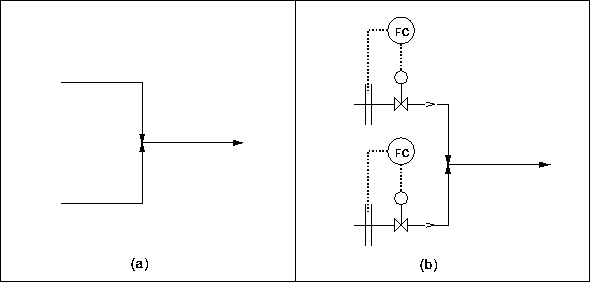
Consider the exceptionally simple process shown below in figure (a), where two feed streams are mixed together to produce a single product stream. Suppose that what is required is that the two feed streams shall have individually specified flowrates. A suitable control system for this would be as shown in figure (b).
This suggest the validity of the following rule.
Rule 1: `(n-1) out of n'. If n streams join together in a process or part of a process over which mass must be conserved (normally any process), then the flows of only (n-1) of these may be set by flow controllers.
It is possible to prove this formally. As will be seen, further generalisation is also possible.
Conservation of mass requires that the sum of the inflow and outflows shall match over an extended period, but is it necessary to take steps to ensure that this happens from minute to minute? The flows would not always match if there were any possibility of material accumulating within the junction. This will not occur if the fluids are incompressible. This implies that it is necessary to have some mechanism to ensure that mass balances do actually balance. In this example, the design of the process, i.e. simple closed junction and incompressible fluid, ensures that this will be so.
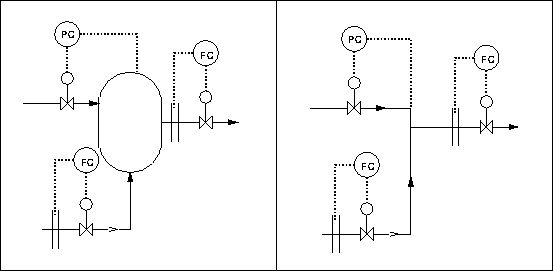
However, consider what happens if we replace the closed junction by an open tank, see below figure (a). Here there is nothing to stop the tank from running dry or overflowing, unless, as in figure (b), we provide the tank with a level controller.

Rule 2: Mass balances must balance. To ensure that mass balances do balance, there must either be an inplicit mechanism in the process, or an inventory controller must be supplied. The valve for the holdup control loop goes on the remaining stream.
Inventory or holdup is measured either by level or some equivalent measurement in a liquid system, or by pressure in a gas system. A simple junction with a liquid system is rather special in being `self regulating' with respect to holdup.
If we wished to regulate the total product rate from a simple mixing process and one only of the feeds, then we may require explicit holdup control for either compressible or incompressible fluids in either of the arrangements below. The vessel in the right hand figure is a closed vessel, which, in the case of a liquid system, would be run full. Whether or not a control loop for pressure is required will depend on the specific process conditions, in particular the source and sink pressures for the flows and the type of device, pump, compressor etc., if any, driving the flow.
Rule 3: Strategic aims. The primary control objectives of a process are set by the strategic aims of the process. These define the basic control stucture.
Thus the fact that flow controllers were placed on the two feed streams in the first example and on the product and one feed in the last was a consequence of a decision by the process designer that these were the streams whose flows were to be fixed. It should thus be clear that the design of a process and of its control system cannot really be separated.
In this section of the course we shall introduce a hierarchical procedure for developing the design of a process control system. This approach will be seen to have a number of advantages. Firstly, it provides a systematic approach to resolving what can otherwise seem to be a complex and unstructured problem. Secondly, it enables us to concentrate on individual parts of the problem, rather than trying to do several things at once. Finally, it corresponds to a standard systematic approach to designing processes, enabling us to evolve the design of the process and its control system together.
The process and control scheme can be looked in to at differing levels of complexity:
There now follows two examples of this hierarchical approach in use. Firstly there is a simple process and then we return to the vapouriser problem introduced earlier.
Consider a rather more sophisticated mixing process.
Process description, (i): The aim of the process is to deliver a fixed amount of product, made by blending together two streams of two constituents, a concentrate and a diluent, and to supply this product to a specified composition.
In this example we shall introduce a hierarchical procedure for developing the design of a process control system. This approach will be seen to have a number of advantages. Firstly, it provides a systematic approach to resolving what can otherwise seem to be a complex and unstructured problem. Secondly, it enables us to concentrate on individual parts of the problem, rather than trying to do several things at once. Finally, it corresponds to a standard systematic approach to designing processes, enabling us to evolve the design of the process and its control system together.
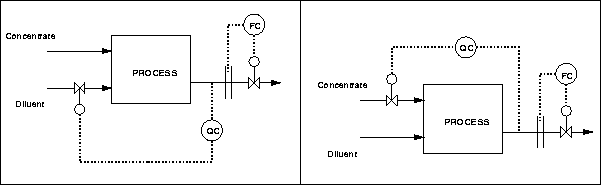
Starting from the above statement of the process requirements, viz specified product rate and composition, without reference to any detail of the process itself, other than the input and output streams, we can define immediately a part of the control system structure, as shown below. Here the, unspecified, process is shown as a box. It is clear that the product stream will require flow control and that that can be implemented as shown. It is also clear that composition measurement and some sort of composition or quality control loop will be required. Half of this loop can be immediately defined, and is also shown.

The following heuristic approach, based on the ideas of Douglas is recommended.
This algorithm is a rather general one for any kind of design.
Here we can apply the following heuristic or rule-of-thumb.
Heuristic : Small streams. Manipulate small streams rather than large ones in important control loops.
This has a number of justifications. Firstly, small valves are cheaper than large ones, so it may be possible to save money. Secondly, small valves can be manipulated more quickly and precisely than large valves, and so a control loop with a smaller valve will often work better.
Clearly, the concentrate stream will be a smaller one than the diluent, and so we will choose to follow up the right hand alternative where this is the manipulated variable for the composition loop.
Examination of the flowsheet shows that we have control valves on two out of the three streams associated with the process. Since these flows have been set, one to a specific flow and another to ensure that a particular product composition is achieved, the flow of the third stream cannot now be chosen independently, it must match these two flows to ensure that the mass balance is maintained. In fact our `(n-1)' rule, and its corrollary, can be generalised to cover any type of controller with valves on (n-1) out of n streams.
Rule 1a : Generalised `(n-1) out of n'. If n streams join together in a process or part of a process over which mass must be conserved (normally any process), then the flows of only (n-1) of these may be set by control loops other than one regulating inventory within the process or part process.
Without a knowledge of precisely the type of process element on the box we cannot completely define any control loop associated with inventory or holdup regulation, but we do know that we cannot put a control valve on the remaining stream for any purpose other than inventory regulation. We will indicate this on the flowsheet as shown below. The shaded `valve' implies that no other valve may be put on this line. The square, rather than round `controller' indicates that some mechanism, not necessarily an actual controller, will regulate inventory, which might, if measured, be a level, mass holdup or pressure.
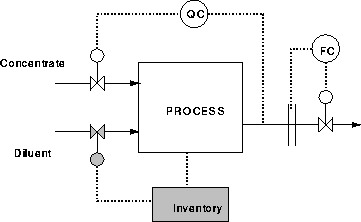
The steps which were followed above illustrate that it is sometimes possible to design a significant part of the control system for a process by reference to:
It will not in general be possible to determine the whole control system with just this information. Further steps in developing this involving `opening up' the box labelled PROCESS in this example into succesive levels of increasing detail. This approach will be explored in later examples. For more complex processes there will be several levels. The purpose of this hierarchical approach is to help the designer to concentrate on the decisions that can be taken at each stage, by presenting details of the process in sequence rather than all at once. This makes the design task easier both by reducing the amount of new information presented at one time, and by allowing some earlier decisions to be finalised and thus removed from the list of tasks still to be tackled. A glance ahead at a complete process flowsheet will enable the reader to appreciate how daunting a task placing the control loops on a flowsheet might be if this approach is not adopted.
This example may however be completed in one further level by providing some more details of the process.
Process description, (ii): The process equipment consists of an open mixing tank, followed by an in-line static mixer (a section of pipe with internal vanes or baffles) and a second mixing tank.
The PROCESS box to include this, and with the control system so far defined, is shown below.
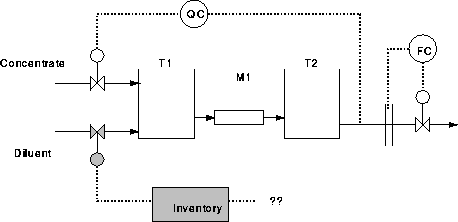
In answering question 2, it is important to realise that in any process, streams do not simply happen! They are their for a reason, and that reason usually defines what will determines their flow.
Refering to process, the incomplete inventory loop cannot be unambiguously completed. Intuition suggests that it should probably regulate the level in T1, and this will indeed prove to be the case, but we cannot be certain of this yet.
The two new streams, from T1 to M1 and from M1 to T2, have no obvious strategic requirements for regulation of flow or composition.
However, T2 has two streams, one of which has its flow set by the product flow control loop. The tank is not self regulating, and so an level controller must be placed with a valve on the feed stream as shown.
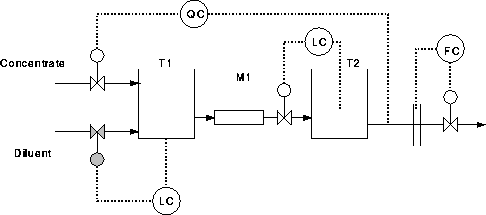
All streams being accounted for by having explicit control valves or implicit regulatory mechanisms determining their flows, the control scheme is now complete.
This was a very simple process. However, there were potentially a significant number of alternative process structure, not all of which would have worked. We applied a logical procedure, each of whose steps could be justified with reference either to a knowledge of the process or the rule which have been proposed, and ended up with a complete, and workable, control system with four loops.
Before proceeding to more complex examples, let us review how the three questions set out at the beginning of the section were answered.
The question of `how many?' was not posed or answered explicitly in this example. As will be seen later, it is sometimes convenient to do so. However in this case it was subsumed in the question of `which?'.
The question of `which quantities to measure' was answered in two ways. Firstly by reference to the Strategic aims of the process rule. This established the outlet flow and concentration as regulated quantities. Further strategic regulated variables, other than inventories can often be established by by reference to identified adjustable variables, but in this process there were no others.
Secondary regulated variables are usually inventories and are identified by the (n-1) and mass balance rules.
It is clear that there cannot be more adjusted variables than there are streams whose flows can be manipulated independently. These were all identified in this process by the requirement for inventory regulation. In general we can use the following Rule both to identify adjustments and to check the final control system structure.
Rule: flows do not just happen. Stream flows in a process do not just happen. Either a valve or a mechanism (such as continuity) must set the flow of every stream.
Here there will almost invariably be alternatives. To identify these and help choose between them we have one firm Rule, and some guiding heuristics.
Rule: Cause-and-effect. An adjustment chosen to pair with a measurement must have an effect on that measurement.
This is rather obvious. It is nonetheless given a name in the control literature where it is called structural controllability.
A number of heuristics serve to aid choice. One has been given, the Small streams heuristic. Here are two more.
Heuristic: immediate response. Prefer pairings in which the measurement responds immediately, rapdicly and unambiguosly to the adjustment.
Their are a number of important quantitative elements embodied in this heuristic. These are dealt with in detail elsewhere.
Heuristic: noninteraction. An ideal adjustment should affect its paired measurment and no other measurements.
We now have sufficient understanding of how to develop whole process control schemes to tackle the vaporiser problem.
Redrawing this `process' as an input-output block yields the structure shown. In the block we have distinguished two sub-blocks, noticing that while both feed and steam enter the process they are subject to separate material balances.
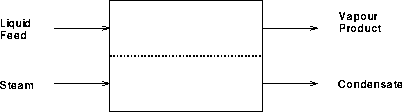
Objective 1. suggests that we should place a flow controller on the vapour outlet as shown in figure (a). Noting that the process fluid side of the block has only one input and one output, the feed stream may be `blocked' for any purpose other than inventory regulation as shown by the shaded valve.
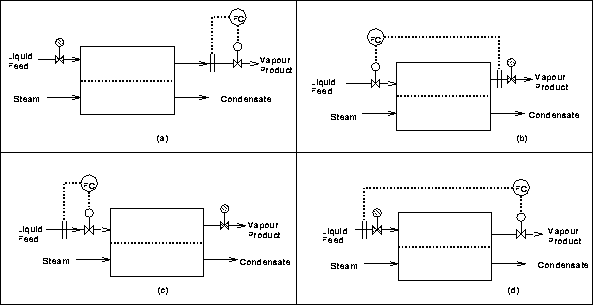
Heuristic: close adjustment. It is usually better to make an adjustment as close as possible to the measurement with which it is paired.
Also because the sub-block has only two streams, the scheme in figure (c), which regulates the feed flow would also serve to maintain the product rate once inventory regulation was provided. This is clearly a less direct way of performing the specified task, and depends of the satisfactory operation of the inventory control system. It is therefore avoided on the basis of a further Heuristic.
Heuristic: direct action. Prefer the the structure which manipulates the regulated quantity most directly. In particular, avoid arrangements which depend on the satisfactory operation of additional control loops.
The final structure, figure (d) violates both of the above guidelines.
Objective 2. explicitly states that the vapour temperature shall be regulated, as shown below, (a). Since all streams on the process side are set when inventory regulation is added, only the steam rate can be adjusted. If this is done on the steam supply, then the condensate outflow must be adjusted to maintain the steam side material balance, figure (b).
N = C - P + 2
N is the nuber of extensive thermodynamic variables which may be chosen or set, C is the number of components and P the number of phases. Here P = 2, there being both vapour and liquid present and so:
n = C
However, the feed composition is fixed and because of the requirements for material balance, the vapour will have this same composition. Specifying the composition on a C component stream fixes (C-1) concentrations, leaving one intensive variable which can be fixed by a control system. This can be either temperature or pressure, but clearly not both independently.
Rule: Phase Rule. The Phase Rules still says:N = C - P + 2
The control system structure has been completely defined at the input-output level. This is rather unusual, but it is now very easy to open up the block and turn the conceptual controllers into `real' ones, see below figure (a). Note the special form of inventory regulation on the steam heating side using a steam trap, essentially a very small vessel with an internal level control system to allow steam and condensate to be disengaged.
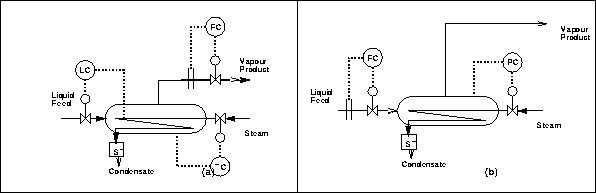
Heat transfer from the coil to the fluid happens only in the liquid phase. If too much vapour leaves the vessel, the liquid level falls, uncovering some of the steam tubes. Thus the heat transfer area falls, reducing the rate of heat transfer and the rate of vaporisation. Normal operation will be with the tube bundle partly uncovered.
This arrangement will only be acceptable if this is allowable, e.g. with relatively low temperature steam. Another problem could be that there will always be some liquid boiling dry on the exposed tube surface. This could tend to degrade and build up deposits.
Finally, to show that, in this system, temperature and pressure regulation are equivalent, the temperature control loop on the steam has been replaced by a pressure controller.
It is possible to determine the number of variables in a process which it is permisable to regulate by a formal mathematical procedure. In the previous example it this was not necessary, as identification of the number of available adjustments served to define this. However, it will sometimes be the case that two or more potential adjustments have the same effect and are alternatives in the sense that if one is used, the other cannot be. It is also possible, in principle, to devise a process which is uncontrollable because it has more variables to regulate than there are adjustments available.
The mathematical technique is called degrees of freedom analysis. It can be carried out in a number of ways, but essentially it consists of counting the number of equations required to describe the process or part process under consideration, and the number of variables which appear in these equations. The excess of variables over equations represents the number of quantities which may be set to arbitrary values, for example by a control system.