Section 2.2: Examples
Equations in Engineering Problems
The following example show how the different categories of equation
arise in various situations.
Example 1: Simple Mixing Process
See Figure below
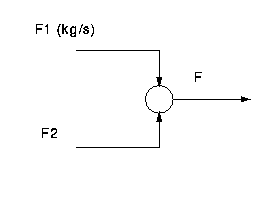
Consider the behaviour
of the process over a period of time when the two flowrates do not
change, and any disturbances to the
process resulting from previous changes in the flows have settled out.
total outflow rate = total inflow rate
F1 + F2 - F = 0
Notes
- The condition of no change, etc, means that the process may be
said to be at steady state.
- The properties of the process variables, i.e. the flows, are
associated with one value at one point in the process, e.g.
an inlet stream. There are a finite
number of such points and in particular, not a continuum. This
is called a lumped system.
- The equation is an algebraic equation,
i.e. no integrals or derivatives.
- The solution is a number.
Example 2: Tank Filling
See Figure below
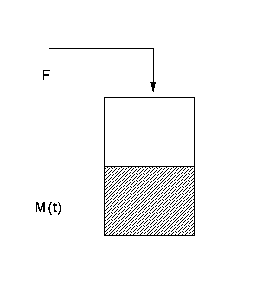
Liquid flows at a rate F kg/s into a tank. The mass of
material in the
tank initially, at say time t=0 is
M0 kg. There is no outflow
from the tank.
rate of accumulation = net rate of inflow - net rate of
outflow

With initial condition: M(t) = M0 at t=0
Notes
- This is a dynamic situation because M changes
with time.
- This is a lumped system because the property,
holdup, is associated with a single point and is not distributed
in space. That is, we can talk about the mass of material in the
tank
but not the mass of material at point x in the tank.
- The equation is an o.d.e. whose independent variable is
time.
- The solution is functional variation of M(t).
Example 3: Heat Transfer in a Slab
See Figure below
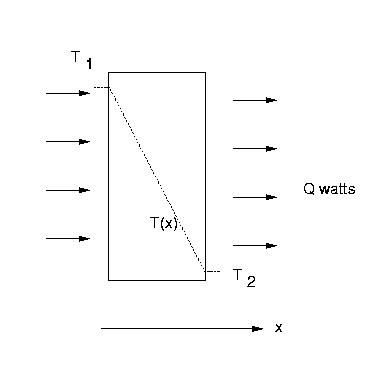
Heat flows at a constant steady rate Q watts across a
uniform slab. Each
side of the slab is held at constant temperature.
The temperature of the slab, of cross sectional area A and
thermal conductivity k, varies across its thickness
x and is denoted by T(x).

Notes
- This is called a distributed system because a property,
the temperature of the slab, is distributed in space.
- There is one spatial dimension.
- There is no change in time because the heat flow is constant,
thus this is once again a steady state situation.
- The equation describing the system is an ordinary
differential equation.
- The independent variable in the o.d.e. is
distance.
- The solution is the
functional variation of the distributed property with distance,
i.e. T(x).
Example 4: Time Varying Convection by Plug Flow in a Pipe
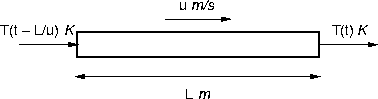
This is described by a p.d.e. whose independent variables
are time and distance along the pipe. Consider the situation
where the temperature T is changing with distance
x down a pipe of total length L
where the velocity of flow is u.
This is described by the convective flow terms of the
Navier-Stokes equation:

Although this is a complicated looking equation it turns out
to have a simple solution. The temperature of the fluid leaving
the pipe at time t is exactly the same as
the temperature entering the pipe at a previous time
(t - L/u) since L/u is the residence
time for the fluid in the pipe.
More Complicated Situations
- Steady state systems in two or more dimensions are described
by p.d.e.s whose independent variables are all the spatial dimensions
involved.
- The unsteady state of distributed systems involves equations
containing p.d.e.s with independent variables of both space and
time.
- The solutions of p.d.e.s are functions or functionals.
- Distributed problems may contain integrals, leading to
integral equations.
Summary and Further Points
- Steady state lumped systems are described by algebraic
equations
- Steady state distributed systems by o.d.e.s in distance
- Unsteady state lumped systems by o.d.e.s in time
- Anything more complicated by p.d.e.s.
- All these are different kinds of equations, requiring different
solution methods.
- Algebraic equations also describe dynamic systems with no capacity
and thus instant response.
Move back to Section 2 Index