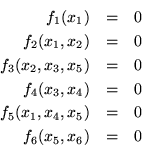
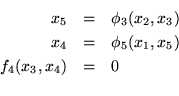
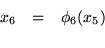
Consider:
We note that:
We can call the subset (f1,f2) the head of the equation set, andf6 the tail. (In general, of course, the equations need not have been numbered and ordered so that these appeared at the top and bottom of the list of equations!)
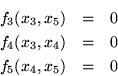
The group (f3,f4,f6) is called a partition
of the set of equations
and represents a subset that must be solved simultaneously. If we
delete x1 andx2, which will be known after solvingf1
andf2, the
partition is:
![\begin{displaymath}\left[
\begin{array}{c c c c c c}
1 & & & & & \\
1 & 1 & & &...
... \\
1 & & & 1 & 1 & \\
& & & & 1 & 1 \\
\end{array}\right]
\end{displaymath}](images/bimg4.gif)
The partition is identifiable as the the group of equations with above diagonal elements.

These can be solved as follows:
Rearrange f3 to give x5 , in terms of x3 , i.e:


 terminate; otherwise adjust x3
This procedure is referred to as tearing the set of equations, reducing them here to solution for a single unknown x3 , called the tear variable.
The incidence matrix:
![\begin{displaymath}\left[
\begin{array}{c c c}
1 & & 1 \\
1 & 1 & \\
& 1 & 1 \\
\end{array}\right]
\end{displaymath}](images/bimg9.gif)
has one variable with a supra-diagonal element; this tells us that we can reduce the equations to solving for a single variable.
The procedure can be represented:
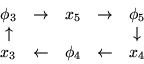
Clearly any one of x3 , x4 or x5 could have been chosen as the unknown.


 , the output set of the equations
contains all the xi from
, the output set of the equations
contains all the xi from  but not necessarily in
the same order. For the example above ...
Head:
but not necessarily in
the same order. For the example above ...
Head: 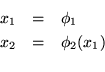
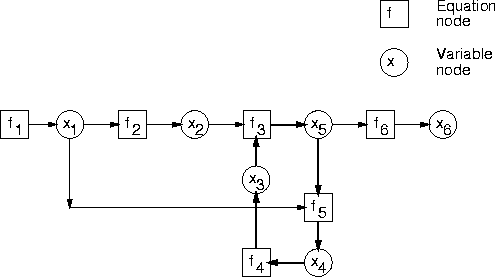
One and only one edge may leave an equation node. One and only one edge may enter a variable node. Partition cycle shown bold.
Given a liquid mixture of n components with mol fraction composition, at pressure P , determine the temperature T , and the composition yi of the vapour in equilibrium with the liquid.
| P*i - P*i(T) | = | 0 | (1) |
 |
= 0 | (2) | |
| yi - ki xi | = 0 | (3) | |
 |
= 0 | (4) |
With the equations in the above sequence and the output set, say for a
binary, chosen to be:

![\begin{displaymath}\left[
\begin{array}{c c c c c c c}
1 & & & & & & 1 \\
1 & 1...
...1 \\
& & & & 1 & 1 \\
& & 1 & & & 1 \\
\end{array}\right]
\end{displaymath}](images/bimg22.gif)
Next - Section 3.5.3: Example Questions
Return to Section 3 Index