The following are all algebraic equations.
| x - 3 = 5 | (1) |
| sin 3x = y cos x | (2) |
| a x2 + b x + c = 0 | (3) |
Only equations which are linear in their unknown have a guaranteed analytical solution:
| a x = b | (4) |
| a x - b =0 | (5) |
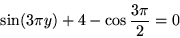
However, consider:
 |
(6) |
 |
(7) |
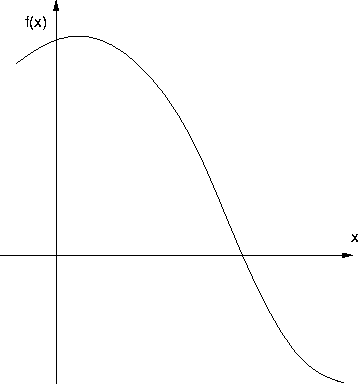
Where is the solution ?
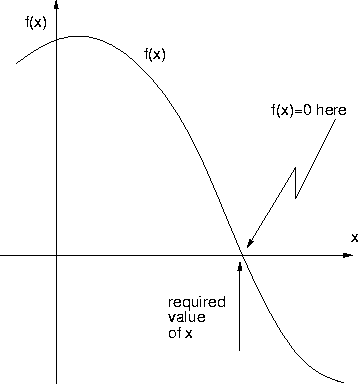
It clearly lies on the x-axis at the point where the function f(x) value is zero.
Given an equation
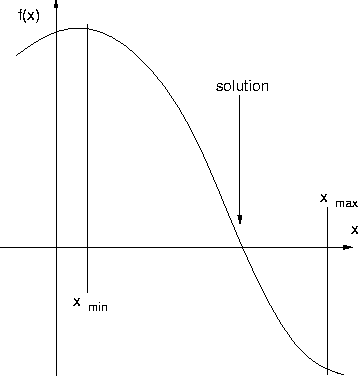
Intrinsic:

Operational: cooling water temperature, vessel pressure, etc
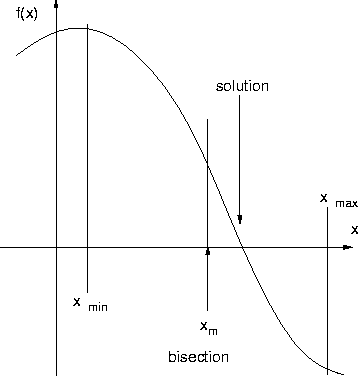
First bisection gives a new, better x
Next discard redundant bound, here xmin
Replace it by xm which becomes `new' xmin
Repeat
 sign fu.
Abandon with error message if not so.
sign fu.
Abandon with error message if not so.
 then stop
Accuracy:

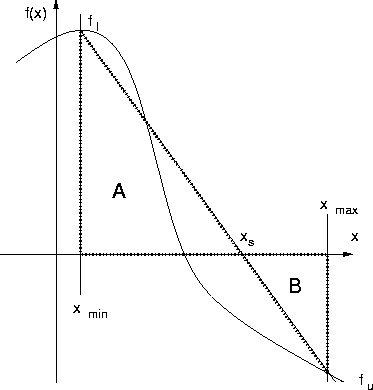
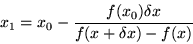
Same algorithm as bisection, but a different way of choosing the new value.
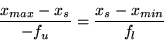
From similar triangles A and B:
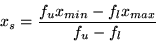
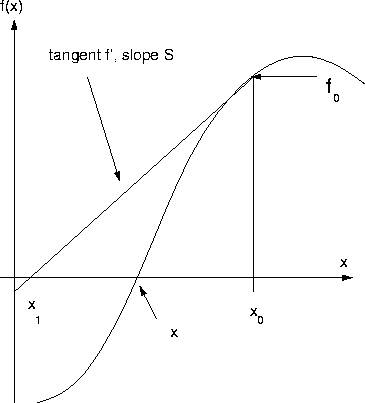
Bisection uses only sign,
Secant uses value,
Newton also uses slope.
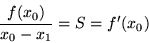
Hence:
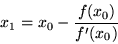


Then:
NB, if we set:
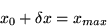
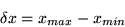
...this gets back to the secant formula.
E.g. consider:
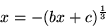
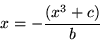
Sufficient condition for convergence is:

In general this class of repeated substitution method cannot be guaranteed to work. An exception is a situation where the physics of the system ensures that the above condition is always met. One example of this is in solving process recycle problems.
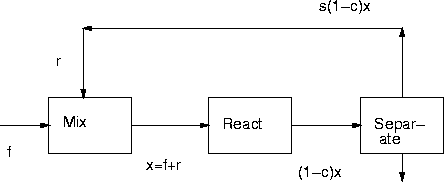
If c is the fractional conversion in the reactor and s the fractional recovery of the recycled reactant in the separator, then the classic procedure of `guessing a recycle stream' is equivalent to solving for x , the amount of reactant entering the reactor:
Here r=s(1-c)x) so:
Thus is the RHS expression, i.e.:

And:
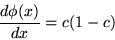
Since c and s are both fractions, this must be less than unity.
Repeated substitution methods should be avoided unless it is certain that this condition is fulfilled. Even when it is, other methods are usually better.
Back to 3.3 Iterative Solution of Single Algebraic Equations
Back to Section 3 index.