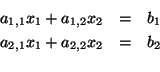
Solve:
This is in a convenient form for obtaining x1:
In symbols:
Eliminate x1
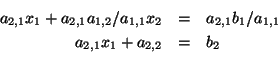
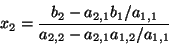
Substituting:

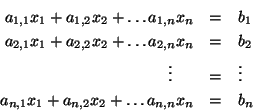
Set of n equations
![\begin{displaymath}\left[
\begin{array}{c c c c}
a_{1,1} & a_{1,2} & & a_{1,n} \...
...egin{array}{c}
b_1 \\ b_2 \\ \vdots \\ b_n
\end{array}\right]
\end{displaymath}](images/dimg6.gif)
|
(1) |
This may be written in matrix-vector form:

     !Start the elimination loop.....
       do i=1,n-1
     !... go down the matrix by rows i...
     !.. reducing all the other rows k..
       do k=i+1,n
       pivot=(a(k,i)/a(i,i))
     !This is the number to multiply each
     !row of equn i by before subtracting it..
     !.. along each row k ..
       do j=1,n
       a(k,j)=a(k,j)-pivot*a(i,j)
       end do
     ! .. and also the constant.
       b(k)=b(k)-pivot*b(i)
     !
       end do
     !.. go on to next row with current elimination
     !end do
     !.. and then eliminate next equation
     !
     !.. and finally solve the one remaining
     !equation for x(n)
       x(n)=b(n)/a(n,n)
     !--- Elimination Complete ---------
     !Back substitute for other x() ...
       do l=n-1,1,-1
       x(l)=b(l)
       do j=l+1,n
       x(l)=x(l)-a(l,j)*x(j) end do
       x(l)=x(l)/a(l,l)
       end do
     !----- Finished ------------
       program lintest
       implicit none
     !test linear solver
       integer :: n,i,j,ifg
       integer, parameter :: max=50
       real :: a(max,max),x(max),c(max)
       print *, 'Solver for small sets of linear equations...'
       print *, 'Enter number of equations, less than ',max
       read *, n
       print *, 'Now enter coefficients ...'
       print *, 'i.e. ',n+1, ' numbers per row...'
       do i=1,n
       print *, 'Elements for row ', i, ':'
       read *, (a(i,j), j=1,n), c(i)
       end do
       .......
       print *, 'Matrix and constants are:'
       do i=1,n
     !check print
       write(6,'(7f10.4)') (a(i,j),j=1,n), c(i)
       end do
       call solve_linear (a,max,x,n,c,ifg)
       write(6,*) 'flag =',ifg
       write(6,*) 'solution..'
       write(6,*) (x(i),i=1,n)
       end program
Next - Section 3.6.2: Example Questions
Return to Section 3 Index