 of species i to a reference
component r is defined as:
of species i to a reference
component r is defined as:
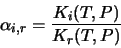
A convenient measure for use particularly in approximate vapour-liquid equilibrium calculations is the relative volatility of one species with respect to an arbitrarily chosen reference or key component.
Relative volatility
of species i to a reference
component r is defined as:
For an ideal system:

Hence:
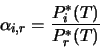
Although relative volatility is thus a function of temperature T, much of its usefulness results from it being a rather weak function of temperature, particularly for nearly ideal mixtures. This is because the slope of vapour pressure versus curves tend to be similar for similar components.
Thus over a reasonably limited range of temperatures relative volatility may be estimated at a suitable `average' or reference temperature and then regarded as a constant.
For an n component mixture there are of course n relative volatilities. However if the reference component is taken as on e of those in the mixture, which would be the usual practice, then the volatility of this component w.r.t. itself will be one.
Next - Example Questions
Course Organiser Last Modified 2/9/00