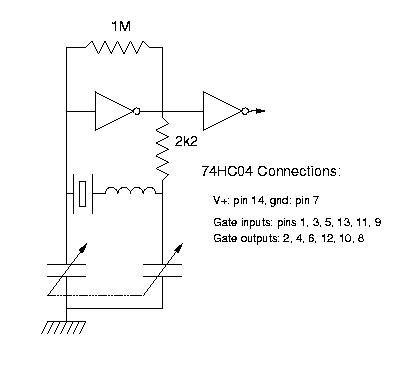
More recently introduced 3.695 MHz resonators cover much of the rest of 80m. Typically we can obtain 3.568 to 3.734 MHz (166kHz span). A single resonator can cover nearly all of the `rest' of 80m. I have tried two switched resonators. Layout should try to minimise stray capacity as this will reduce the maximum frequency.
After seeing George, G3RJV's article in the January '98 Practical Wireless, I tried putting a 10 µ H axial inductor in series with a single and a pair of 3.69 MHz resonators, with the following results.
I originally used a 350pf dual gang air variable. High quality capacitors usually have lower minimum capacity, but this only matters if you want to squeeze the absolute maximum high frequency out of the circuit. Almost as good performance can be obtained with the cheaper and more compact plastic variables.
For Top Band 2MHz resonators will cover from about 1.92MHz to above 2.02 MHz, This covers a useful part of the band including all the novice section. There is clearly no point in using a second resonator as the top end coverage is more than adequate.
Adding series inductances of 10, 22 and 47 microhenries brings the bottom end down to 1.95, 1.89 and 1.875 MHz respectively, with the upper limit still reaching the top of the band. Higher inductance results in loss of stability.
Not all 10MHz resonators will stretch to the top of the 30m band. However, by minimising the capacitance of the variable and stray capacitance I can get better than 10.170MHz consistently using the basic CMOS circuit and Maplin resonators (part number DJ38R). The cheapest variable capacitor available (Maplin FT78K, 142+59pF) is satisfactory with the trimmers set to minimum capacity. Tuning is significantly nonlinear, typically from 0 to 50% meshed positions cover the top two thirds of the frequency range.
The capacitance at the gate output (for a CMOS oscillator) seems to have a larger effect than that on the input, so when a twin gang capacitor is used put the smaller capacity gang, in this case the 49pF `oscillator' section, on the output (e.g. pin 2 on the 74HC04).
From Murata's data sheets, the temperature stability of their type MG resonators, for frequencies up to 6.3MHz, is nearly twice as good as that for the type MT, used at higher frequencies. Since the stability is a percentage of operating frequency, it will be best to use as low a frequency resonator as possible. The 30m VFO using a 10 MHz resonator is thus a bit marginal. Similarly using higher harmonics of the MG resonators would be undesirable for a transmitter, although OK in receiving aplications.
However, better stability can be obtained by using resonators at
less than 6Mz and mixing with a crystal oscillator.
A `breadboard' was built up using an NE602 in
the cicuit below.
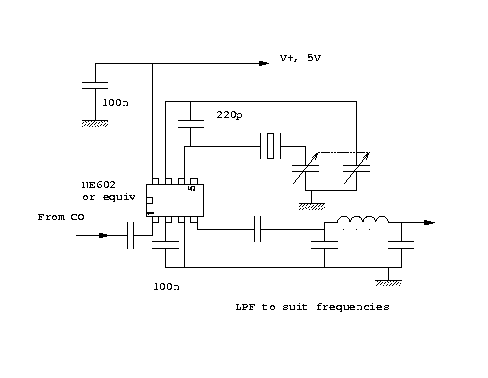
This test version used a 10MHz resonator, which is not recommended, for
reasons of stability, but a 24MHz crystal
was to hand, This provided coverage of 20m from below 13.990MHz
to 14.280 using a 350pF variable.
A suitable output network is used in the `Gremlin' TX (Sprat 82). It would be better to use a 6MHz
resonator and a 16MHz crystal, see table below.
In principle one can use either additive or subtractive mixing. The latter leads to an intrinsically cleaner design as most of the spurii will be above the output frequency. Also a lowpass, rather than a bandpass filter can be used to clean the signal up.
Looking for common computer frequency crystals, all obtainable new for less than about £ 2.0, and keeping to resonators of 6MHz or less, the following all look possible. Experiments suggest that 4MHz resonators can be pulled reliably down by 100kHz and 6MHz by about 150kHz, and both of these can be increased by using suitable inductors. It is easier to pull down than up, another advantage of subtractive mixing in this application.
| Band, MHz | Resonator, MHz | Crystal | 7 | 4 | 11 or 11.059 | 10.1 | 6 | 16 | 14.0 | 6 | 20 | 18.068 | 6 | 24 | 21.0 | 4 | 25 | 28.0 | 4 | 32 |
I haven't yet identified a suitable combination of a cheap crystal and stable resonator for 12m.
As described by GM3RXU in Sprat 86, 40m can also be covered without a separate crystal oscillator by feeding the VFO from pin 7 of the NE602 through the capacitor to pin 1. A separate crystal oscillator will however give better stability.
However, the original Epiphyte (Sprat 81) used a 4.19 MHz resonator which in my version with a 100pF capacitor pulls between 4.155 and 4.212 MHz. This lets my Epiphyte cover 3.70 to 3.76 MHz. Testing another resonator in a CMOS circuit with a twin gang capacitor doubled the span to about 120kHz down from 4.258 MHz. I now know also that 4MHz resonators can be pulled by more than 200kHz with an added 10µ H inductor, so coverage of the entire 80m SSB band is in principle possible with a 455kHz IF.
I have built a simple DSB exciter from a single NE602, feeding a standard electret microphone into pin 1 through a 330nF capacitor and using the built in oscillator with a resonator. This is not advisable with a simple VFO as the high level audio signal, typically several hundred mV, will pull the frequency causing a rather nasty FM-ing effect. The resonator seems to be sufficiently stable to avoid this problem, at least as far as my ears can detect. An output of a few milliwats of DSB (at 1k5 impedance) should be available, as the chip has 17dB of gain, and could be used to feed a simple linear.
Since a 3.69MHz resonator will pull down to 3.60MHz, this could form the basis of a simple phone transmitter for the new Novice 80m allocation.