Mathematical Description
Mathematically, proportional control could be expressed as:

- V is the adjustment or signal for the adjustment from the controller.
 is the error.
- = S - L
- L is the measured value of the controlled variable.
- S is the setpoint.
- K is the proportional constant, named as the gain which shows the sensitivity of the control.
- Vo is the signal output when no error exists.
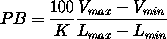
The gain is often replaced with another parameter, called the proportional band, PB. This quantity is defined as the error required to move the final control element over its whole range and is expressed as a percentage of the total range of the measured variable. What is the relationship between K and PB.
According to this definition we can see that the whole range of the final control element adjustment should be Vmin to Vmax.
At point Vmin

At point Vmax

The error required to move from Vmin to Vmax will be





Dynamic Response
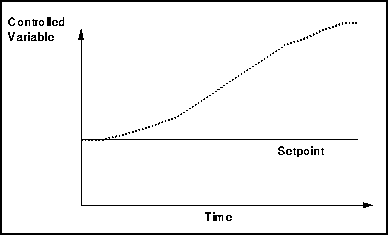
Now let's examine the dynamic response of the proportional control. Assume the process is at steady state and the level is at the setpoint. At time = 0, an increase in the inlet flowrate, regarded as a disturbance, enters into the process. If no control action is taken, i.e. the outlet flowrate is not altered, the level (controlled variable) will increase.
Advantages
The advantages of this type of controller are
- It is relativly simple and easy to design and tune
- It provides good stability
- It responds very rapidly
- Dynamically it is relatively stable
Disadvantages
From the response curve to a step change in the input two features should be noted. These are two points which make proportional control unsatisfactory.
- Offset
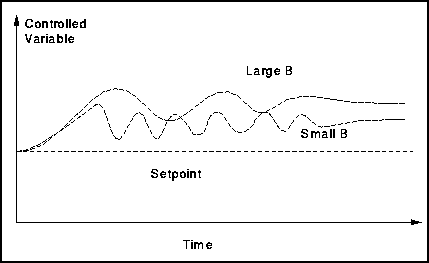
For a sustained change of load, the controlled variable is not returned to the original or desired value, but attains a new equilibrium value termed control point. The difference between the control point and the desired value (set point)is referred to as offset.
The reason for this offset with proportional action is that the control action is proportional to the error. Consider the above simple level control system. For the step increase in the flow of liquid into the tank, in order to maintain the level, the valve on the outlet must be opened wider. This will only occur if there is a continuous output from the controller. The output itself can only exist if there is an error signal supplied to the controller. In order to maintain this error, the level will rise above the desired level at the new control point, hence create an offset.
- Overshoot
There is a significant time of oscillation, or in other words, overshoot. Although the period of this oscillation is moderate, this, in some cases, could be highly undesirable.
Integral and Derivative Control
Two other common control techniques are used to eliminate the problems found when using proportional only control. These are known as integral and derivative control. Sometimes they are used individually but more often they are combined with proportional control. A more mathematical definition can be found in a later section.
Integral Action
Integral action gives an output which is proportional to the time integral of the error. It is also called reset control. It is possible to use integral action itself, but this is not a common situation.
P and I Control
Integral action is generally applied with proportional control, yielding so-called proportional and integral control (P+I). This combination is favorable in that some of the advantages of both types of control action are available.
The main advantage of P+I is that it can eliminate the offset in proportional control.
The disadvantages of P+I are that it gives rise to a higher maximum deviation, a longer response time and a longer period of oscillation than with proportional action alone. This type of control action is therefore used where the above can be tolerated and offset is undesirable.
Derivative Action
This kind of action gives an output which is proportional to the derivative or the rate of change of the error. It is also known as rate control. This kind of action could not be used alone in practice. This is because its output is only related to the rate of change of the error. The error could be huge, but if it were unchanging, the controller would not give any output. Thus although it is theoretically possible, it is practically impossible.
P and D Control
Derivative control is usually found in combination with proportional control, to form so-called P+D. By adding the derivative action, lead is added in the controller to compensate for lag around the loop, and so P+D can eliminate excessive oscillations. A disadvantage is that it can not eliminate the offset although somehow it makes it smaller.
Proportional, Integral and Derivative Action
In applications, sometimes the above three action are combined together to set up the proportional plus integral plus derivative action, i.e, P+I+D.This combined action is able to:
- eliminate the offset due to the existence of integral action
- reduce the maximum deviation and time of oscillation, which is a compromise between the advantage and disadvantage of P+I and P+D
Examples
The aim of this module was to introduce the various types of control action. In the Case Study Section and Virtual Control Laboratory there is a level control experiment which allows the user to practice what they have learned in this section. i.e. it is possible to vary the deadzone on an on-off controller, see the effect of altering the proportional band etc.