
Figure 1 - Feedback Control Loop
The basic type of controller is the Feedback Controller.
Feedforward controllers also exist but are more complicated to implement. Here we will describe the use of feedback controllers.
In feedback control the variable required to be controlled is measured. This measurement is compared with a given setpoint. The controller takes this error and decides what action should be taken by the manipulated variable to compensate for and hence remove the error.
Figure 1 - Feedback Control Loop
The disadvantage is that the disturbance has to enter and upset the system before it is eliminated.
A feedback control loop can have one of two objectives.
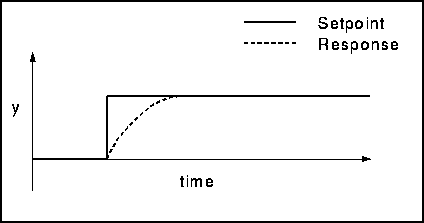
Figure 2 - Servo Control
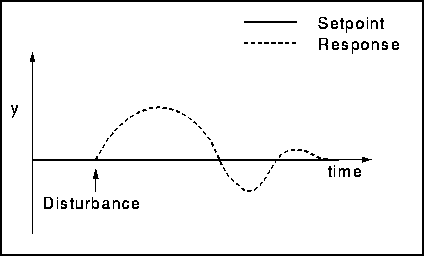
Figure 3 - Regulatory Control
The first type of controller that we will study is the proportional controller. This controller sets the manipulated variable in proportion to the difference between the setpoint and the measured variable. The bigger the difference, the greater the change in the manipulated variable.
The equation that describes a proportional controller is

 is the constant of
proportionality, ususally called the controller gain
is the constant of
proportionality, ususally called the controller gain
The advantage of proportional control is that it is relatively easy to implement. However the disadvantage is that when implementing a proportional only controller there will be an offset in the output. Thus there is always a difference between the setpoint and the actual ouput. The reason why this is so can be shown by means of an example.
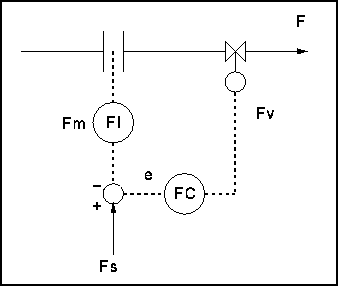
Figure 4 - Diagram of Flowrate Example

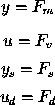
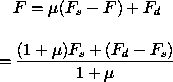
However, let us now consider what happens when the value of the setpoint changes from 50 to 60 with Fd staying constant at 50. First the relevent equation is shown and then the table below summerises the results for different gains.
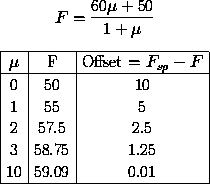
 must have a value and so there must be an error.
There are two ways of eliminating this problem.
must have a value and so there must be an error.
There are two ways of eliminating this problem.
The first is hard to achieve since it requires very accurate knowledge of the process, and would require changes whenever the setpoint is moved.
The second leads to problems of rangeability and sensitivity. Suppose the gain is 10, then measurement noise of 1% of the total range will cause the control valve to move over 10% of its total travel. This is unacceptable.
To remove the offset integral action is required and so PI control is normally used. It works by summing the current controller error and the integral of all previous errors. It may be thought of as a way of automatically calculating the quantity ud. Proper tuning - described in a subsequent section - of the integral part of a PI controller can improve its performance.
If the error e is defined as

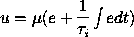
 is the reset time of the controller
Alternatively, we can differentiate this expression to get

As before
So

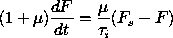
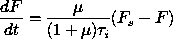
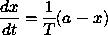

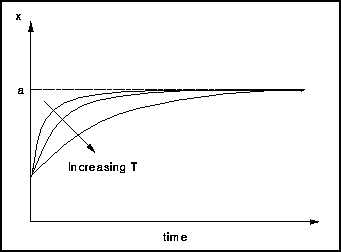
Figure 5 - Response Curve
For the flow control system with integral action we see that
is small and/or
is large