 , the controller gain
 , the integral reset time
, the controller gain
, the integral reset time
, the integral reset time
, the controller gain
, the integral reset time
In the second section on modelling processes we looked at
For the first of these we saw that there were three parameters necessary to define the process. These are
 , the process gain
 , the process time constant
The aim of this section is to introduce a method of matching the personality of the controller to that of the process so as to achieve the optimum controllability. In other words how do we go from the process parameters to the controller parameters. The method introduced uses the open loop response of a process and works best with a delay-followed-by-first-order-lag. There are many other tuning methods which look at other aspects of the process in order to tune the controller. A couple of these will be discussed in a later section.
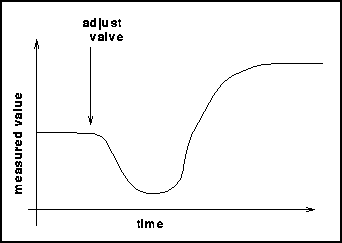
You will see later in the interactive exercises that this is very difficult to control!
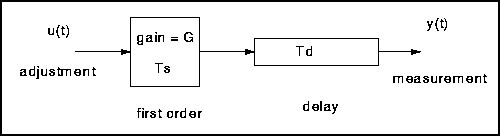
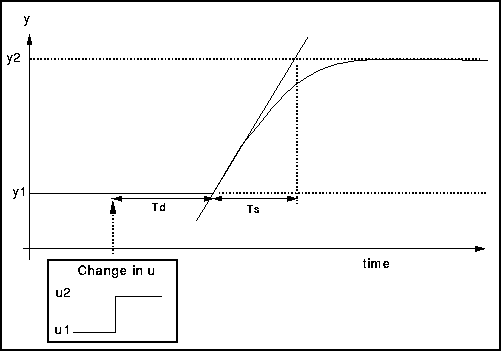
The method is outlined below.
The diagram above shows how to obtain these values.
| Controller Type | Gain | Reset | Derivative |
|---|---|---|---|
| P | Ts / Td | - | - |
| PI | 0.9 Ts / Td | 3.3 Td | - |
| PID | 1.2 Ts / Td | 2.0 Td | 0.5 Td |
and the process steady state gain,
G.
* G
Therefore by substituting all the values in for the above and re-arranging we get the following values for the controller parameters:
| Controller Type | Controller Gain, |
Reset | Derivative |
|---|---|---|---|
| P | (Ts  ) / (Td ) / (Td  ) ) |
- | - |
| PI | (0.9 Ts ) / (Td ) |
3.3 Td | - |
| PID | (1.2 Ts ) / (Td ) |
2.0 Td | 0.5 Td |
Advantages of this method are
However there are also Disadvantages
If we are lucky it may be similar in form but different in detail as shown below.
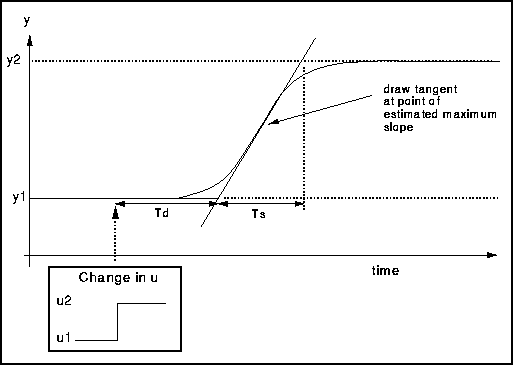
However if we are unlucky the response may be like this...
In a process the measurement y is strictly speaking a dimensioned quantity: temperature, pressure, flow etc.
The adjustment u is usually a flow, so that the
process gain,
 , will in general have
odd dimensions! This also makes it hard
to interpret or compare gain values.
, will in general have
odd dimensions! This also makes it hard
to interpret or compare gain values.
In practice, both measurement and adjustment have a maximum range determined by the measuring instrument or valve. It is best to work with scaled quantities always expressed as a fraction or percentage of range, e.g.
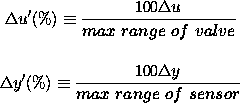

Alternatively, if the gain is very small, say 0.01, then for a large change in u there is hardly any response in y.
What is required is a gain of around 1. This enables both input and output to be used to their full ranges which in turn improves the controllability.
So if this definition of the gain is used it is clear from a glance if a suitable value has been obtained or not. In this case simply use the value of the gain from the first table above along with the dimensionless process gain above to obtain the dimensionless controller gain.

Firstly remember that you have a value of the dimensionless gain for the controller as evaluated above.
Now we define the Proportional Band, P, as the reciprocal of the dimensionless controller gain.

Return to Start of Module 2.4: Controller Design and System Modelling