A matrix is just a fancy word for a table. In fact we considered deleting all references to matrices in this course and substituting the word `table' throughout. It would have worked perfectly well, but the term is used extensively everywhere in the world of modelling and optimisation.
Before reading this section, look at the revision notes on vectors (1.1.1) if you have not already done so.
A matrix is simply a table, and like any other table, its meaning is defined by whoever created it. In practice there are a number of special uses of matrices which are understood to have particular meanings. However, these meanings are specific to the application, and not intrinsic in the tabular matrix representation.
| Month | Oct | Nov | Dec | Jan | Feb |
| Topic | Algebraic Eqns | Linear Eqns | DAEs | Optimisation 1 | Optimisation 2 |
| Weight | 10 | 10 | 15 | 7.5 | 7.5 |
This is a table or matrix having 3 rows and 6 columns, and so is referred to as a `3 by 6' matrix. The total number of entries or `elements' is thus 18. None of the entries is blank.
Notice that the `meaning' of the table or matrix has had to be defined in a particular context. Without this additional information it would not have been possible to know how the matrix was to be interpreted. In this particular matrix the elements are of differing kinds: some are numbers, some are words 9or abbreviated words) and other are phrases. There are no obvious `operations', such as addition or multiplication, which can be defined for the complete matrix, although such may be possible for certain special types of matrix, this is only because someone has designed the matrix to have these particular properties.
Tables, with which most of us are familiar and quite happy, often have information built into them which aids in their interpretation. Conventionally the first row and column provide such `hints' and are often of course emphasised by lines and borders, typefaces etc. as shown below. However it is still the layout of the table which ultimately must correspond to some prior definition of its meaning.
| Month | Oct | Nov | Dec | Jan | Feb | |
| Topic | Algebraic Eqns | Linear Eqns | DAEs | Optimisation 1 | Optimisation 2 | |
| Weight | 10 | 10 | 15 | 7.5 | 7.5 |
The mathematical uses of matrices may seem harder to comprehend because because of the absence of explicit headings and other hints. However, as will be seen, we can write these in for ourselves if we wish.
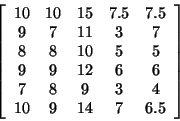
Finally in the same context, consider the following table which might show the marks obtained by a group of 5 students in the assignments.
| 10 | 10 | 15 | 7.5 | 7.5 |
| 9 | 7 | 11 | 3 | 7 |
| 8 | 8 | 10 | 5 | 5 |
| 9 | 9 | 12 | 6 | 6 |
| 7 | 8 | 9 | 3 | 4 |
| 10 | 9 | 14 | 7 | 6.5 |
Here all the information is numerical, and might more easily be envisaged as being manipulated using `matrix algebra'. However, it is also clear that as there are no headings the program, spreadsheet or whatever will have to know (a) that the first row represents maximum possible marks and (b) who are the students associated with each row.
As with vectors, it is often convenient to define a single symbol to represent the entire matrix. Conventionally this will be an upper case boldface letter, e.g. A.
If we wish to refer to individual elements of the matrix, then these can be identified by their row and column numbers. Conventionally the lower case form of the matrix name with subscripts indicating the row and column numbers, in that order, is used to identify an individual element.
Thus if A is the above matrix, then:
a1,3 = 15
a2,4 = 3
a6,3 = 15
a6,6 = 6.5
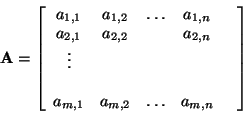
In general, if A is a `m by n' matrix, i.e. a table having m rows and n columns, it can be written in terms of its elements as: