

There is also a connection between the physical system and the equations which describe it, in that certain types of equation describe certain situations or phenomena. An understanding of the relationship between the `real' situation and the types of equations is thus essential in developing mathematical models in the form of equations.
There are three major categories of equation.
sin 3 x = y cos x
a x2 + b x + c = 0
The solution is a numerical value for a single equation, or a set of numbers, as many as there are unknowns and equations, for a set of algebraic equations.
One significant characteristic of an equation is whether it is linear or nonlinear in a particular variable. The equation is linear only if the variable appears to a power of one, and does not appear as the argument of a higher function.
Thus only the first equation above is linear in x. However the second equation is linear in y, and the third is linear in a, b, and c.
There is more about algebraic equations in section 3.1.
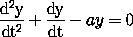
NB: these must all be `Straight d' derivatives if the equations are o.d.e.s.
There are two different kinds of variable in this type of equation: the dependent and independent variables. There may only be one independent variable, and this will appear on the bottom line of the derivatives. The variables which appear on the top line are the dependent variables and there should be the same number of these as there are equations.
The solution is the dependent variable or variables as a function or set of functions in terms of the independent variable.
There is more about o.d.e.s in section 4.1.
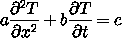
P.d.e.s are hard to solve! The solution is the dependent variables as functions of all the independent variables.